
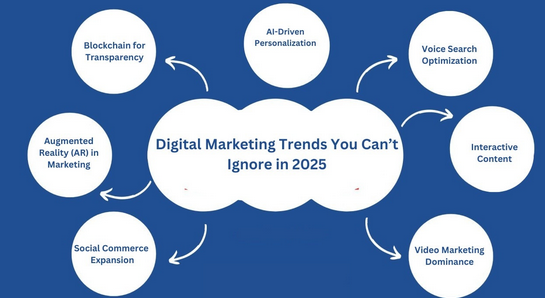
Digital marketing in 2025 is not a gentle evolution — it’s a full-speed reorientation. AI moved from “nice-to-have” to the engine under the hood; privacy changes reshaped how we collect and use data; and attention economics made short, authentic content the dominant currency. If you’re building a brand, leading a marketing team, or trying to get more ROI from limited ad spend, you need to understand which trends are meaningful (and actionable) — not just flashy buzzwords. Below is a practical, detailed guide to the top digital marketing trends for 2025, why they matter, and how to apply them.
1. Generative and Conversational AI: the new marketing workhorse
Why it matters: 2025 is the year AI became deeply operational across content creation, customer service, ad optimization, and search. Marketers use generative AI to write ad copy, produce multi-version creatives, and generate video scripts — and conversational AI (advanced chatbots/virtual assistants) now handles complex lead qualification and support flows. This changes staffing, speed, and expectations: campaigns can be prototyped and iterated far faster, and personalization scales more cheaply than before.
How to apply it:
-
Use AI to generate multiple variants of headlines, descriptions, and short video scripts, then test at scale (A/B/n testing with automated allocation).
-
Implement conversational funnels: deploy chatbots that collect intent data, qualify leads, and hand off high-value prospects to humans.
-
Keep humans in the loop for brand voice, ethics checks, and high-stakes messaging; use AI for volume and optimization.
Pitfalls to avoid:
-
Blindly publishing AI outputs without brand review — hallucinations and tone mismatches still happen.
-
Over-automating customer interactions that require empathy or highest-value negotiation.
2. Search is changing: “AI search” and generative answers
Why it matters: Search is moving beyond 10 blue links. AI-powered search and agent-style assistants compress the funnel by answering queries conversationally, often without a single click. That means discoverability now depends on structured, authoritative content that AI systems can ingest and synthesize — and on formats (e.g., short FAQs, product schemas, transcripts) that feed LLMs and apps.
How to apply it:
-
Adopt “Generative Engine Optimization” (GEO) practices: structure content for machine consumption (clear intent signals, structured data, summaries).
-
Produce concise, factual snippets (FAQ-style answers) that AI can quote.
-
Monitor branded SERP behavior and optimize for appearing in AI-generated summaries.
3. Short-form video dominance — storytelling in 15–60 seconds
Why it matters: Short-form video (TikTok, Reels, Shorts) dominates attention. By 2025 many reports show short-form formats claim overwhelming share of social engagement and time spent. For most audiences, short-form provides the highest reach and fastest virality — but only if the content feels native, immediate, and authentic.
How to apply it:
-
Prioritize vertical, mobile-first creative and hook-first editing (0–3 seconds).
-
Shift budgets to creator partnerships and user-generated content (UGC) that feels native to platform context.
-
Recut long content into short, platform-native teasers and micro-tutorials.
Metrics to track:
-
Completion rates and watch time (not just views).
-
Engagement per impression (likes/comments/shares per 1,000 impressions) — this correlates to organic reach.
4. Privacy-first data strategies & the cookieless reality
Why it matters: Privacy regulation and browser changes forced marketers to rethink tracking. In 2024–2025 the industry faced rolling changes to third-party cookie policies and privacy sandbox initiatives. The practical consequence: less reliable cross-site tracking, more emphasis on first-party data, and a need for privacy-preserving measurement.
How to apply it:
-
Double down on first-party data: build email lists, loyalty programs, in-app identifiers, and hashed customer records.
-
Invest in privacy-first analytics (server-side tracking, modeled attribution, aggregated measurement).
-
Use consent management platforms and be transparent about data usage; trustworthy brands get better opt-ins.
Risk management:
-
Don’t rely on any single vendor’s “workaround.” Design measurement that can tolerate gaps and use modeling (probabilistic attribution) to estimate lift.
5. Hyper-personalization driven by AI and predictive analytics
Why it matters: Personalization in 2025 is less about “Hi {first_name}” and more about contextually relevant experiences powered by predictive models — the right offer, on the right channel, at the right time. AI can predict product affinity, churn risk, and lifetime value to prioritize marketing actions automatically.
How to apply it:
-
Build predictive segments (next-best-offer, churn-risk) into your CRM and automate campaigns.
-
Use dynamic creative optimization (DCO) so ads adapt copy, imagery, and CTA based on predicted intent.
-
Personalize on owned channels (email, push, in-product) where you control the experience and data.
Ethical note:
-
Avoid excessive hyper-targeting in sensitive categories; respect privacy and fairness.
6. Social commerce and creator-driven buying journeys
Why it matters: Social platforms became storefronts. Shoppable posts, livestream commerce, and creator recommendations compress the purchase journey — often removing the website click entirely. Creators as trusted intermediaries or “discovery engines” are central for many categories (beauty, fashion, fitness, tech).
How to apply it:
-
Work with creators for integrated shoppable content and live demos.
-
Optimize product feeds and catalog accuracy to reduce friction.
-
Treat creators as channel partners: track sales, offer affiliate structures, and co-create exclusive bundles.
7. Immersive experiences: AR, VR, and phygital marketing
Why it matters: Augmented reality (AR) product try-ons, virtual showrooms, and phygital experiences blurred online and offline shopping. Customers want to “try before they buy” in low-friction ways; AR filters, 3D models, and virtual events provide that. These technologies became accessible to mid-sized brands in 2025.
How to apply it:
-
Add AR try-on or 3D product previews for high-consideration products (glasses, apparel, furniture).
-
Host hybrid events (virtual + local pop-ups) to link digital interest with in-person sales.
-
Use spatial analytics to see which virtual placements drive conversions.
Cost considerations:
-
Start small with SDKs and template AR experiences rather than custom VR worlds.
8. Creator economy evolves into creator-first brand strategies
Why it matters: Creators are now strategic assets — not one-off influencers. Brands forge long-term relationships, provide co-creation resources, and integrate creators into product development and loyalty programs. This improves authenticity and repeatable ROI.
How to apply it:
-
Create multi-tiered creator programs: ambassadors, power creators, micro creators.
-
Offer creators analytics and creative support (templates, editing, AI dubbing/localization).
-
Track lifetime value from creator cohorts rather than single campaign clicks.
9. Multilingual & localized content — reach beyond English
Why it matters: Platforms added language features (AI dubbing, localized creatives), and audiences responded. Reaching regional language audiences — with culturally adapted content — unlocks growth in markets like India, Southeast Asia, and Latin America. AI tools now assist with high-quality dubbing and localization.
How to apply it:
-
Localize not only language but context: cultural references, local festivals, and pricing.
-
Use AI dubbing and subtitling for faster localization, then review with native speakers.
-
Test localized creatives and optimize by region.
10. Ethical, sustainable, and transparent marketing
Why it matters: Customers reward brands that align with sustainability and honest practices. Transparent messaging about sourcing, data use, and product impact builds loyalty. In 2025 consumers increasingly expect proof (certifications, verifiable claims) rather than vague promises.
How to apply it:
-
Label sustainability claims precisely and provide verifiable evidence (supply chain snapshots, lifecycle numbers).
-
Use “values-aligned” segmentation to connect products with mission-minded audiences.
-
Be prepared to back up claims; greenwashing risks reputational harm.
11. Automation across the funnel (ad ops, creative ops, and measurement)
Why it matters: Automation now coordinates creative testing, bid strategies, and attribution modeling. Platforms’ automated bidding and creative optimization tools are mature; marketers who leverage automation at the right layer (strategy + guardrails) get more efficient performance.
How to apply it:
-
Use automated bidding for campaign scaling, but set performance guardrails and KPIs.
-
Automate creative production pipelines: templated designs + AI text variations + human finalization.
-
Implement automated reporting with anomaly detection to flag campaign issues quickly.
12. Visual & voice search — design for new query types
Why it matters: Visual search (camera-based search) and voice queries change how users describe intent. Image-based discovery and voice shopping require new kinds of metadata (alt text, product tags, audio-optimized content).
How to apply it:
-
Optimize product images with structured metadata and multiple angles.
-
Create short, conversational content suited for voice results (FAQs, how-to answers).
-
Ensure product pages are easily crawlable and include schema markup.
13. Measurement evolution: modeling, incrementality, and creative-level ROI
Why it matters: With fragmented tracking, advertisers moved to experimental and model-based measurement (holdouts, incrementality tests, media-mix models). Creative-level measurement (which creative drives lift) is now as important as channel attribution.
How to apply it:
-
Run regular incrementality tests to validate channels and tactics.
-
Use experiments for audience expansion and to validate new creative concepts.
-
Combine first-party conversions with modeled estimates to build a resilient view of performance.
Quick playbook — how to prioritize these trends for your business
-
Start with first-party data: If you have none, prioritize capture (email, account signups, loyalty). This underpins personalization, measurement, and long-term value.
-
Adopt generative AI safely: Use it to scale ideation and production, but keep quality control. Pilot on non-critical assets first.
-
Shift to short-form, creator-led content: Reallocate some media budget to creator partnerships and short, native videos.
-
Rework measurement: Implement privacy-first analytics and plan for incrementality tests.
-
Test one immersive or AR use case: Choose a product that benefits from “try before you buy.”
-
Localize strategically: Identify top regions for growth and localize content (language + culture) for those pockets.
Practical checklist for 90-day execution
-
Build or expand a first-party data program (opt-ins, segmented lists).
-
Run 3 AI-powered creative experiments (headlines, short videos, email variants).
-
Launch a creator pilot with clear performance KPIs.
-
Implement one conversational AI flow (lead qualification or support).
-
Start a privacy-first measurement plan (server-side tagging + modelled attribution).
-
Create localized short-form assets for top 2-3 markets.
Final thoughts: adapt, don’t chase every shiny trend
2025’s theme is convergence: AI, privacy, short-form content, and creator economics intersect. The brands that win will be those that:
-
Prioritize durable capabilities (first-party data, creative systems, incremental measurement).
-
Combine automation with human judgment (strategy, brand voice, ethics).
-
Invest in creator and local partnerships to stay authentic at scale.
This isn’t the year to chase every trend — it’s the year to build flexible systems so you can adopt the next wave faster. Start with the fundamentals above, run focused experiments, and scale what proves ROI-positive. Good luck — and if you want, I can convert this into a 90-day tactical plan tailored to your industry and budget.